The Personal Website of Mark W. Dawson

Containing His Articles, Observations, Thoughts, Meanderings,
and some would say Wisdom (and some would say not).
The Fire of Mankind
Fire – unexpected and uncontrollable is a primal fear of all animal species. No species knew when or where a fire would occur, and when it occurred it was uncontrollable. To be afraid of fire, and to flee from fire, was necessary for survival. To this day this is true for all but one species- Hominoidae, and one genus – homo, as the cladogram of the superfamily Hominoidae shows the descendant relationships of the extant hominoids that are broadly accepted today.
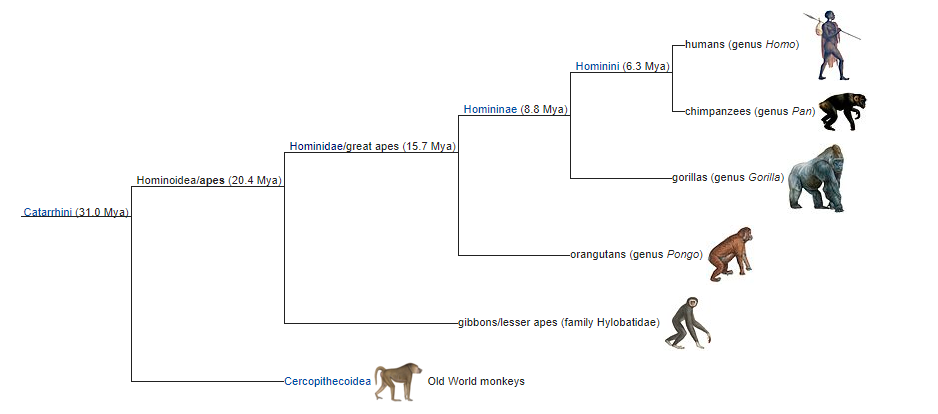
When I was young, we were taught that the major differences between homos and other species was a tool making capacity. However, recent discoveries reveal that other hominoids have crude tool making skills. We were also taught that language was also a difference, but again crude language skills have been demonstrated in other hominoids. So, what is it that differentiates homo from other hominoids? I would answer – FIRE!
Somewhere in the distant past homo lost its fear of fire and learned how to tame and use fire. Scientists estimate that the cooking of food began at about 500,000 years ago or before. It was this loss of fear and cooking that started homo on an evolutionary path to intelligence. We do not know the reasons why homo lost its fear of fire, or how it learned to control fire. I would speculate that after a fire the homos went back to their habitations and observed the destruction. They also observed the carcasses of the animals that were killed by the fire, and being scavengers, they carefully approached the carcasses then retrieved them for food. As they approached the carcasses, they approached the embers of the fire and received its warmth, a warmth they could utilize on a cold night or day. This brought them closer to the fire where their fears lessened. It also kept their predators away, as the predators were afraid of approaching the fire. It is not hard to imagine them eventually poking at the fire with sticks and animal bones which started the long process of learning how to control the fire.
The other event that occurred was that homo consumed cooked flesh when they retrieved the carcasses. This is a huge cultural advancement. All animals consumed uncooked food. Herbivores fed chiefly on grasses and other plants, while Carnivores fed on flesh, and Omnivores, which homos are, fed on both animal and vegetable substances. All animals spent a significant amount of their daily activities on food gathering, eating, and digesting food. Some estimates put this time up to 80% of the waking hours animals spend on food foraging, eating, and digesting activities. Cooking is a form of pre-digesting food outside of your body, and significantly reduces the amount of time for eating and digestive activities. Also, digesting food takes a considerable amount of metabolic energy, energy saved with cooking that could be utilized for other purposes. Therefore, homo had more time for activities outside of digestion, which led to a developing brain. This developing brain also allowed them to progress from scavenging to hunting for food. As they became hunters and shared their food, they also developed social skills which increased their intellectual abilities. How much of these changes were due to eating cooked foods specifically, versus the increased use of other processing techniques such as pounding or cutting foods is also a question. Did the adoption of cooking—generally a communal process in humans—require changes in our social behavior, given that other apes rarely share food? An interesting graphic that tend to support this hypothesis is:
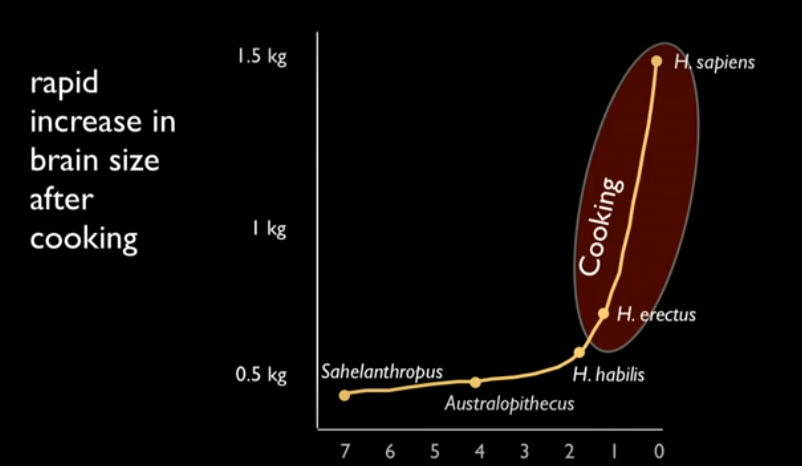
Source: Graphic from a TED Talk by Suzana Herculano-Houze
The homo losing its fear of fire, and learning how to tame and use fire, was the first step in controlling and mastering their environment. It allowed their brain to grow and become intelligent. It was also the first steps in understanding the environment and manipulating the environment for their benefit, which eventually developed into science, mathematics, and technology.
Of course, this topic is a matter of considerable scientific discussion and debate, and this short article does not do justice to this topic. For more information I would suggest that you review the following:
“Food for Thought: Was Cooking a Pivotal Step in Human Evolution?” The dietary practice coincided with increases in brain size, evidence suggests - as a Scientific American article outlines.
“Why Fire Makes Us Human” Cooking may be more than just a part of your daily routine, it may be what made your brain as powerful as it is - is examined in a Smithsonian article.
“What’s so special about the human brain?” a TED Talk by Suzana Herculano-Houze
“Catching Fire: How Cooking Made Us Human” by Richard Wrangham is a book that examines this topic.
Disclaimer
Please note that my Science Articles disclaimer applies to this article, as it does to all of my science articles. These science articles are for the purposes of general scientific information that is understandable to a layperson, so that they can grasp the concepts of the topic being discussed. As such, they are neither as accurate nor as thorough as academics, scientists, engineers, and science writers strive to achieve. My hope is that these science articles will be informative and interesting, and that they will pique the reader's interest in exploring these topics in further detail via the hyperlinks that I have embedded into these articles.
If you have any comments, concerns, critiques, or suggestions I can be reached at mwd@profitpages.com.
I will review reasoned and intellectual correspondence, and it is possible that I can change my mind,
or at least update the content of this article.